Cost Minimisation Model
What is the added value of innovation? When the concerned innovation is a potential gamechanger in healthcare, patient’s benefit are forefront and immediately noticed. However, sometimes the benefit is only indirectly noticeable for the patients, e.g. in case of an improved drug administration method during surgery, which can facilitate the procedure, while the patient himself […]
The value of ‘Net Monetary Benefit’

How to indicate if an innovation is worthwhile to pay for in view of the claimed benefit it will bring? Per assumption, innovation will change ‘something’ versus the current situation . In theory, the goal of innovation is to generate an improvement versus the current situation. Healthcare is a business focusing on optimisation of resource […]
Health state transition models
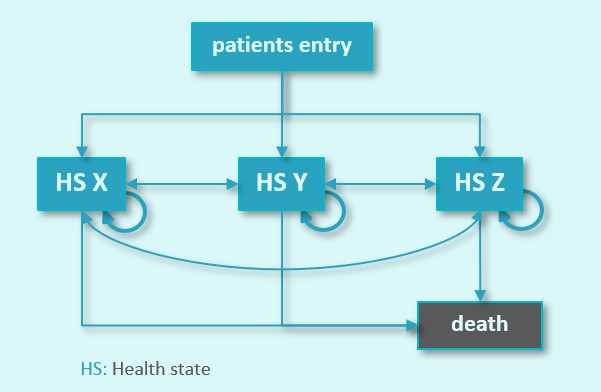
‘Simulation models’ are an important instrument to simulate the impact of the introduction of innovation over time. These models are commonly used in health economic assessment to predict the potential costs over time taking into account the clinical efficacy. If the concerned innovation would be introduced on national scale, it would be very difficult to […]
The correlation between the selected reimbursement procedure and the estimated launch date

Imagine you are full of ambition and you recently started a new position in market access. Congratulations! After a few weeks of hard work your company identified you the best suited colleague to estimate the launch date of a new product. The choice is yours! You can read and apply legislation by yourself (good luck), […]
Inflation vs discounting

All market access colleagues involved in the preparation of economic files will be confronted with the aspect of inflation. There are 2 viewpoints versus ‘today’. We can analyse the past or we can estimate the future. In general, most countries rely on official numbers from national offices for statistics like StatBel in Belgium or the […]
Early Access
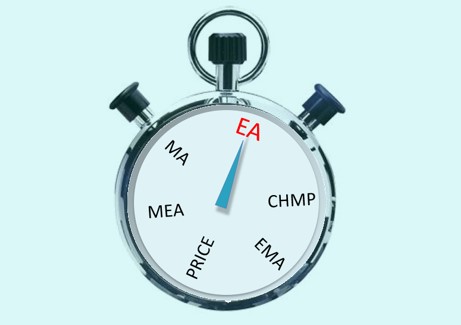
Clinical research is generally driven by the need to provide a solution to an unmet medical need. We all know that the expensive pathway between the ‘eureka’ moment (discovery of a new molecule) and the implementation on the market can take up to 15 years. Within this timeframe, a cascade of studies is initiated (efficacy, […]
Epidemiology data: the creation of spot-on assessments

A robust budget impact estimation starts with knowledge about the volume of patients that can benefit from the concerned innovation. But, how to best estimate the optimal target population? We see quite a bit of variance between dossiers by different companies in the applied methodology. The selected method can be driven by the type of […]
Managed Entry Agreements: Valuable or not?

Investing in ‘uncertainty’? Every innovative medical product on the market is subject to uncertainty. Uncertainty can be situated at the level of the volume (units / patients / events / ..) as well as at the level of medical and societal value and expectations (efficacy / safety / … ). Imagine you are the payor […]
Quality of Life – be vigilant!

Δ = innovation – SoC In general, in the world of market access of health care products, quality of life (QoL) is expressed in ‘utilities’. The healthier you are, the higher your utility score is. When performing health economic assessments, the difference in utilities for patients (delta utility) between the situation without and the situation […]
How to extrapolate a limited data set?
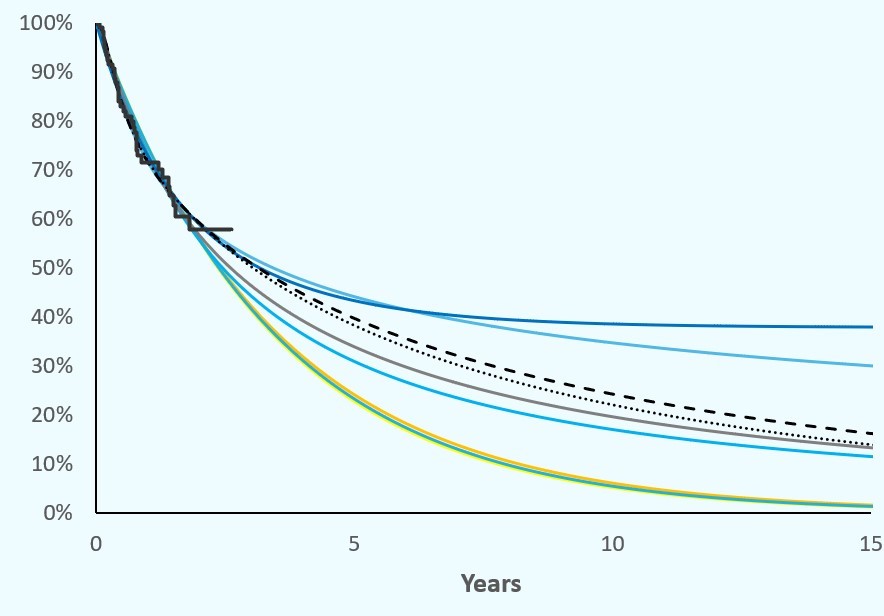
Each health economic analysis starts with clinical data. The trick is to reliably estimate the expected outcome using a limited dataset. In other words, if your sample (clinical study) does not provide mature data (interim data, small number of patients, large variance in results, …), how can you use this data as reliably as possible? […]